My first impression of the Belvedere was not a good one. They do not let you take pictures! For the beginning of the tour I was so resentful that they would not let me take my camera in because it was such a beautiful palace. I got even more upset as I realized that there were not even many objects in the rooms that could be damaged by flash so I truly could not understand why we were not allowed to bring cameras in.
After I, somewhat, got over the fact that I would not be able to document the Belvedere to my hearts content, I was able to appreciate how beautiful Prince Eugenes palace was. The room that I was most struck by was the magnificent ballroom. It was so easy to imagine all the parties and people that used to be in that room. Also, the collection of bust by Messerschmidt was one of the strangest exhibits I have ever seen. His mental disorders were clear in his art but what I was most impressed by was that even at his craziest, Messerschmidt still had such an impressive talent with sculpture.
The other art exhibit in the Belvedere that I was most struck by was of course the Klimt exhibit. I actually like his earlier portraits better than his later works. I am sure that this would have distressed or angered Klimt since this was not the style he was most known for or most proud of. There is something about his portraits of the rich women he did before moving into his more modern and groundbreaking style that I just find captivating. They are all so lifelike and yet they seem to glow from the inside.
Until I came to Vienna the only work I had ever seen of Klimt's was The Kiss. While I liked this painting, I was never as impressed or enthralled as most other women seem to be. During her discussion of The Kiss Dr. O asked us all some questions that I dont think anyone had ever considered about this painting before: What kind of kiss is it exactly? Was it a tender kiss? Was it a passionate kiss? Was the woman enjoying it or just tolerating it? While I found this a very interesting question, there were several girls in our group who actually got quite offended by this. They talked about how for so long this had been a picture which to them personified the beauty of love and passion and to have that called into question seemed to hurt their long held beliefs about The Kiss. In the end, I came to the conclusion that maybe The Kiss is just a kiss. Nothing more and nothing less. I also think, that maybe Klimt painted the piece the way he did so that discussion and opinions like these would arise. Just because one person sees one thing in a painting while another person sees something else does not mean that either of those people are right or wrong and that is the beauty of art.
I was extremely impressed by the Kunsthistorische Museum. Most museums seem to focus largely on the art or artifacts that the building houses and while the Kunsthistorische Museum does indeed have a fabulous collection, I believe that the building itself can be considered art. The exterior of the museum to me at least, is much more beautiful than any of the more modern looking museums that the United States seems to favor. I believe that the dome, statues, and sandstone of the exterior give the building and all it houses a truly regal appearance, which I am sure is what Emperor Franz Joseph I was aiming for in its construction. The inside of the building is even more impressive than the exterior. With all the marble, gold, and paintings, you feel more like you are in a palace than in a museum. I was especially fascinated by the wall paintings done by Klimt. They seem out of place, because the museum from what I saw tends to not house such modern art, and yet, because they are an expression of Austrian art and talent, the paintings also seem to be a perfect fit.
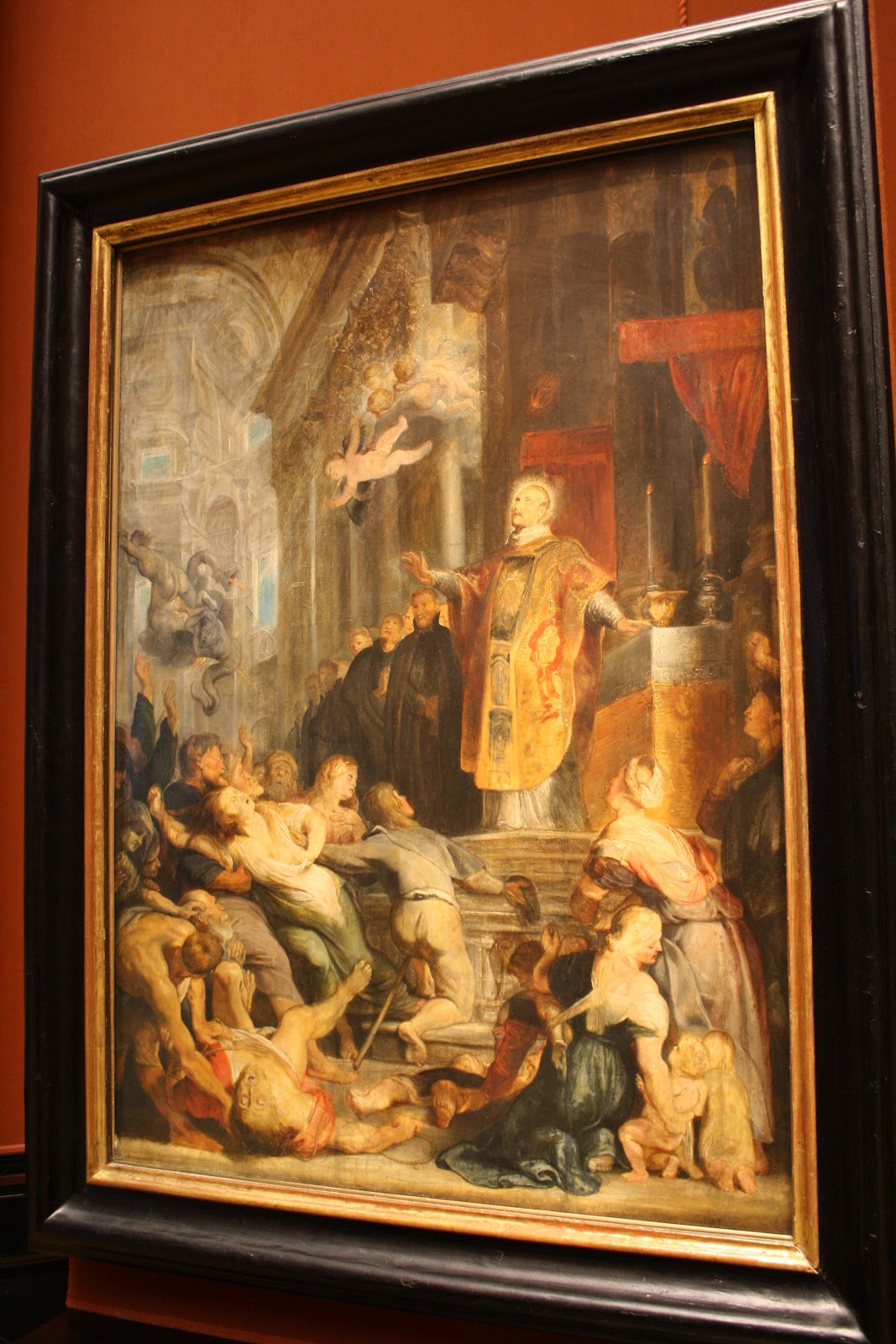
Once we actually started our tour of the museum and the art, something became very clear very quickly. Catholic and Protestant art are as different as the two religions themselves. This is something that Kathy had asked us to look at but even without this prompting the differences between the selections of the two styles were so glaring that I do not think anyone could have missed them.
Catholic art seemed to be all about bold colors, huge paintings, and depictions of the divine while Protestant art seemed to focus more on earthly subjects and use dark and drab colors. I think that the two artists from the Kunsthistorische who best illustrate the extremity of these styles are Peter Paul Rubens and Rembrandt.
Peter Paul Rubens was so in demand that he had a workshop who helped him with his often gigantic pieces. His subjects appear to be mostly great lords, saints, or other divine beings. Although the figures are painting extremely well and most are anatomically correct, there appears to be very little else about these paintings that could be considered realistic. Like Catholic churches, these paintings seem to be more about praising God through lavish art and bold, beautiful colors than about actually depicting scenes from everyday life.
Rembrandt on the other hand occupies the total opposite side of the artistic spectrum. His paintings all tend to be created with extremely dark colors and they almost all portray scenes or portraits that I can only describe as overly realistic. That is not a necessarily bad or a good thing, but it can be a very depressing thing when one looks at the self portraits Rembrandt did. It is very clear that his earthy living has paid a heavy toll on him both physically and mentally. Instead of lifting the viewer up and reminding them of heaven, Rembrandt, and Protestant artistis in general, ground the viewer.
The differences between Protestant and Catholic art seem to accurately illustrate some of the core differences between the two faiths with Catholics often being much more interested in the saints and the divine and Protestants being interested in less fantastic and lavish religious practices.
I just wanted to include some pictures of other paintings I found interesting:
Since I have done quite a bit of traveling with my family I have pretty much always known that there are a lot of other countries who have citizens that are not necessarily the biggest fans of Americans. We tend to have a stereotype of being stupid, loud, and obnoxious. Even knowing these stereotypes, I have never really considered myself to be an overly loud person. I laugh when something is funny, raise my voice when I get excited, and will yell my friends name to get their attention if they are far away. Until I went to Austria I thought that these were relatively normal things to do.
These actions which I consider to be so normal were distinctly abnormal in Austria. My first experience of this was when I was out with maybe three other students walking down Mariahilfer Strasse. It was sometime in the early afternoon so we were not disturbing anyways sleep and yet while we were walking, an older woman turned around and told us to calm down and speak softer. Until she said this I had not even thought that we were being very loud. We were not yelling or screaming, instead we were just talking, laughing, and enjoying ourselves. Immediately I felt ashamed because I do not like disrespecting other peoples' cultures. Everyone else just laughed it off and said that it was fine because we were American tourists so what else could these people expect from us? It was at that point that I realized that if I was going to hang out in any sort of group of students I needed to get used to getting glares and set downs since most of the other students did not seem to care to try and adapt their social behavior.
It was never more obvious that the group had chosen to embrace the American stereotype than when we were at restaurants, on the U-Bahn, or going out to the bars. We were loud, we were obnoxious, and I am sure that all the Austrians thought we were rude. Sometimes I would try to quiet people down but after awhile this seemed a fruitless endeavor so, unless it was a truly ridiculous display of Americanness, I simply decided to embrace my wonderful, although loud, classmates since they were just trying to embrace Vienna and enjoy everything that it had to offer.
I have went to a Catholic school all throughout high school. I went to religion class four times a week, mass once a week, chapel once a week, confession once a month, and I had at least three teachers who were priests or nuns. Given that I am not actually Catholic, I thought that I was pretty well versed in Catholic practices, Catholic churches, and what extreme Catholics are like. Klosterneuburg proved me wrong.
When we first arrived at Klosterneuburg I was amazed by the beautiful architecture and grounds of the monastery. I had always known that Catholics enjoyed their lavish and extravagant Churches, but from what I had seen in the United States, I thought that monks, priests, and nuns lived in less ostentatious places. This is obviously not the case in Europe and is especially not the case for the Augustinian canons who live in Klosterneuburg. This extreme different in living quarters was only the first of the many differences that I learned existed between the priests I knew back here in California and the canons.
Probably the most easily identifiable difference between canons and regular priests is the outfits that they wear. While both groups tend to wear the black cossack, the Augustinian canons wear something called a sarozium, which looks like an extremely long and extremely thin white tie. When we asked Dom Ambrose, the first canon we met who was actually an American, why they wore these, he told us that the practice stemmed from the fact that canons used to wear a white cossack and a white rochet all day long. Over time however, the white habit became black and the rochet was trimmed down into the modern day sarozium. This outfit seems to be much more practical while still showing that the canon is dedicated to serving God not only in Church but in the outside world as well.
The next thing I learned about the canons that truly baffled me was that they do not take a vow of poverty. For years I have thought that this was a fundamental part of joining any Catholic order, but it appears either I was misunderstanding (or possibly not maying attention) in class or my teachers were only teaching us about the way that the priests who worked at our school operated. Instead of taking this vow of poverty, canons instead, from what I understand, take a vow of common property. This means that everything that they have belongs to all of the canons regular. This vow actually makes a lot more sense to me than the vow of poverty that most priests take.
After we left the actually canonry and went to the wine garden I was able to experience one more difference between Augustinian canons and the priests back home. Canons drink like fish. I never saw or heard about any priest I knew in the past drinking alcohol, except of course the wine in the Eucharist but at that point according to Catholic tradition it is blood and not wine. The canons at Klosterneuburg were a totally different story however. They love their wine. They even make their own, although Dom Ambrose the whole time was complaining about the fact that he does not actually like Austrian wines. It was also at this wine garden however, that I noticed a very large similarity between Catholic priests and Augustinian canons. They both tend to be so firm in their beliefs that they are unwilling or unable to bend at all in an argument or discussion. This makes a great deal of sense to me because I know that if you did not have such firm ideas you probably would not have the drive or desire to join a Catholic order.
I had my very first slice of Viennese cake today. I have been hearing all about how wonderful it is from every person who had been to Vienna before. I though that they must have been exaggerating because, yes cake is delicious but really how can cake be special enough that it is the second or third thing people tell you to experience in Vienna? Admittedly, I went into the experience somewhat doubtfully but I was proven wrong very quickly. The cakes here are fantastic! They are the perfect amount of sweet and savory as well as the perfect balance between rich and light. These are the balances that I think American cakes have yet to achieve but that Viennese cakes seem to excel at.
After my first trial of Viennese cake, which is an experience I believe will lead to a very devoted love of Austrian desserts, I was able to see the Stephansdom for the first time. Dr. O gave us a fantastic tour of the church, but the first thing she said that really struck me was actually a question: "What was your first impression of this cathedral?" This is no doubt a very simple question. However, I also think that it is a extremely useful question to use when first approaching a building such as St. Stephans. As soon as she said this I had to think back about what exactly my first impression had been and it can be summed up in one word: Amazing. I realize that this is a pretty bland word to try and use for such a complicated building, but it is the truth. The architecture amazed me. The paintings amazed me. The history really amazed me. And yet, what is odd is that I did not feel overwhelmed by the church despite all of its details and gothic styling. Instead, for some reason, despite the ugly stain glass windows and the grandiose scale of the building, I felt welcome. This sense of ease only increased by every story that Dr. O told us about the different parts of the church. Getting to learn about how the church became a cathedral, why Frederick III was buried there, how Master Pilgrim felt unwelcome, and why bell fell from the tower, while actually standing inside the building was a perfect way to experience history.
I think that my favorite stories as well as my favorite aesthetic aspects of the cathedral were those involving Master Pilgrim. His pulpit is truly extraordinary. The level of detail and obvious skill that went into making the giant stone structure was truly astonishing. Also, I really appreciated the way that every part of the pulpit was thought out. Everything from the toads being blocked by a terrier to the three and four pronged wheels that looked like they were ascending and descending the pulpit were well planned and full of religious symbolism. Even though I am not exactly religious, I do still think that it is a shame that we often do not build or design today with the same thought, care, and symbolism that so characterizes art and architecture of the past. I also really enjoyed the story of the organ case resting on the back of Master Pilgrim. Since he was not Viennese, apparently many locals made fun of him, especially when he was creating the organ case which them claimed would never stay up on the wall. Apparently, at least according to the story, Master Pilgrim then said he would hold the case on his back. Since the organ case is still standing after five centuries, I think that the Master got the last laugh.
Today was the first time I really got a chance to see what I think is probably the largest difference between America and Vienna, which is the fact that everything is closed on Sundays. I had gotten a chance to see a little bit of what this might mean when most stores and banks were closed by five or 6 during the week, but I do not think I was at all prepared for a full day of that. You cannot go to the grocery store. You cannot really go shopping. You cannot go to a pharmacy or drug store. Even some cafes and restaurants were closed. It was a strange feeling coming from some place were almost all stores are open seven days a week and some are even open 24/7. Not being able to go get a late night snack or even lunch food from a Safeway or Ralphs whenever I wanted to was very strange. However, although I thought it out of the norm and somewhat inconvenient, I also believe that such a system is probably better for the Viennese. They appear to actually expect and value time off of work. As opposed to America where work is from nine to five, or in many cases even longer than that, it would be a nice change of pace to live in a society where working adults have the time and energy to engage in activities and enjoyments outside of their careers. This is a freedom that I envy and that I wish the United States would practice more.
Although pretty much all the stores are closed, the museums tend to be open on Sundays and closed on Mondays. Because of this, I think it was a great time to go the Wien Museum. This was the first museum I was able to go to while in Vienna and it was also my first experience with Dr. O since I was unable to do the bus tour. I am glad for both of these facts because I think that the museum was a great introduction to the history of Vienna especially with Dr. O's guidance.
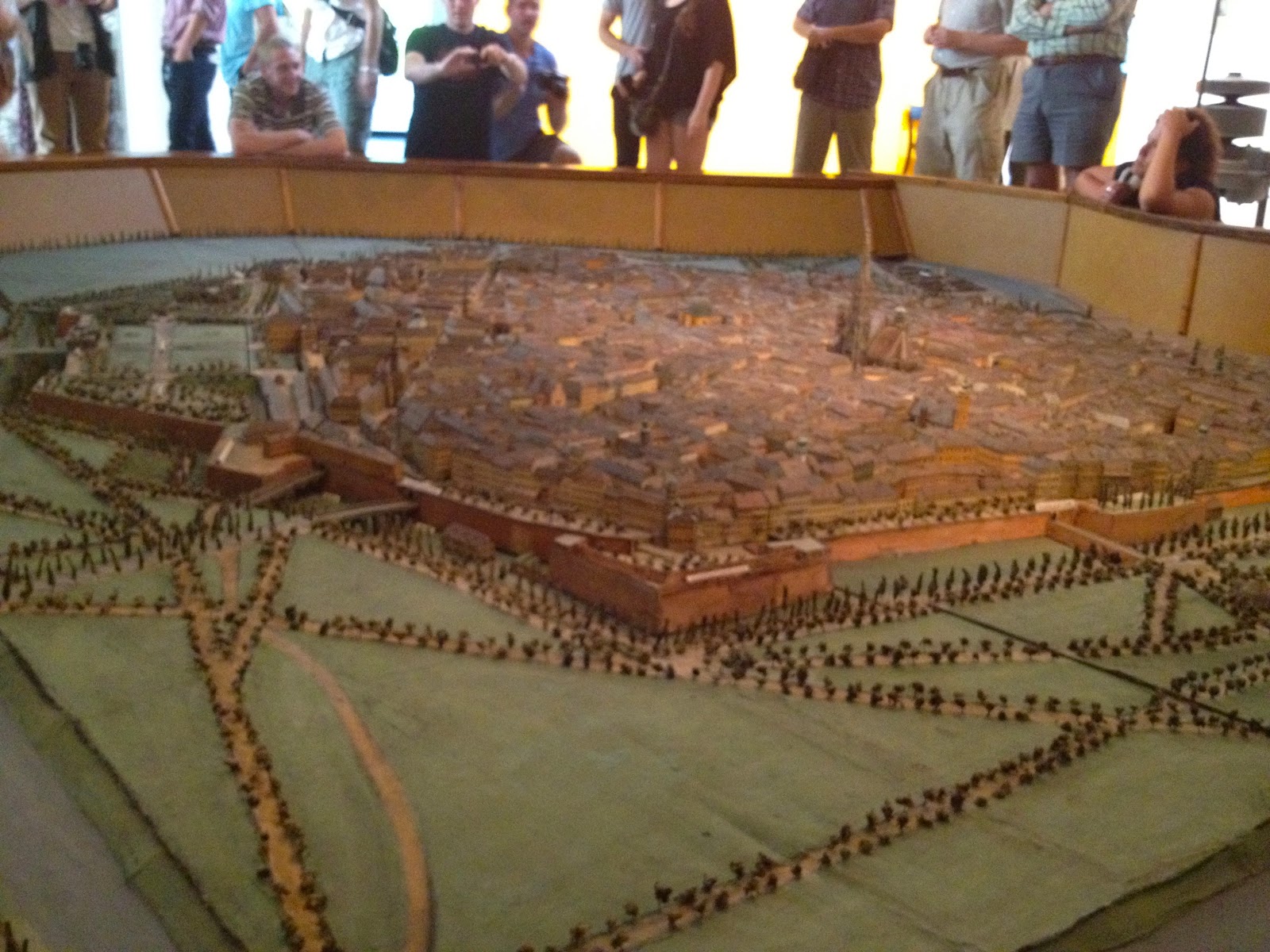
While the whole museum was great, especially getting to see some original stain glass and statues of past rulers, I believe my favorite part of the museum was getting to see the different representations of Vienna throughout history. Being able to see how Vienna transformed from a Roman settlement to the capital city of the Babenbergs and later the Habsburgs and eventually into modern Vienna was absolutely fascinating. I loved getting to see the buildings, structure, and size of Vienna change and grow according to who lived there, what it was used for, and what art style was poplar at that time. Whatever else Vienna may or may not be, it is a city that is always changing in one way or another.
We started out today by taking a walking tour through Vienna. This was also the first time I got to ride the tram instead of the U, which I really enjoyed since you get to see so much more of the city while you travel from one place to the next. The public transportation here in Vienna truly is fantastic! I wish we had something even close to this back home.
We started our walk in the Museum Quarter which I had been to before during the night, but never in the day time and wow does the time of day make a difference there. During the night it is all people, many of who appear to be Viennese, hanging out and socializing. During the day however, it seems to be mostly tourists and it was not nearly as busy although I think that it is much more beautiful because you are actually able to see all the architecture.
Something else that I really enjoy about European architecture in general and Viennese architecture specifically, is that quite a bit of the time it is extremely symmetrical. Personally, I believe that this makes buildings a lot more beautiful, but that could also largely be that asymmetrical buildings really annoy me.
On this tour we also went to the Hofburg for the first time. Through the reading and class, I already knew that this was the seat of the Hafsburgs. What I did not know however, and what I found extremely interesting was that this was where Hitler addressed the Austrians after the Anschluss. Because I found this so fascinating, I decided to do a little bit of research about it. The first thing I was able to find was actually this really interesting website of pictures of Hitler and the Nazis at the Hofburg and other places in Vienna next to pictures of what those places look like now (http://www.thirdreichruins.com/vienna.htm).
This is a video of the speech given. It is absolutely crazy to me how excited all of these Austrians seem! I also had to look up a translation of the speech in English and it goes as follows: Germans! Men and Women!
Within a few short days, a radical change has taken place in the German Volksgemeinschaft, whose dimensions we might see today, yet whose significance can only be fully appreciated by coming generations. In the past few years, the rulers of the regime which has now been banished often spoke of the special “mission” which, in their eyes, this country was destined to fulfill. A leader of the legitimists outlined it quite accurately in a memorandum.
Accordingly, the so-called sel-sufficiency of this Land of Austria, founded in the peace treaties and contingent upon the mercy of foreign countries, was to perform the function of preventing the formation of a genuinely great German Reich and hence block the path of the German Volk to the future.
I hereby declare for this Land its new mission. It corresponds to the precept which once summoned the German settlers of the Altreich to come here. The oldest Ostmark of the German Volk shall from now on constitute the youngest bulwark of the German nation and hence of the German Reich. For centuries, the storms of the East broke on the borders of the Old Mark in the turbulent times of the past. For centuries into the future, it shall now become an iron guarantor of the security and freedom of the German Reich, and hence a safeguard for the happiness and peace of our Great Volk. I know the old Ostmark of the German Reich will do justice to its new task just as it once performed and mastered the old.
I am speaking on behalf of millions of people in this magnificent German Land, on behalf of those in Styria, in Upper and Lower Austria, in Carinthia, in Salzburg, in Tirol, and above all on behalf of the city of Vienna, when I assure the sixty-eight million other German Volksgenossen in our vast Reich listening this very minute: this Land is German; it has understood its mission, it will fulfill this mission, and it shall never be outdone by anyone as far as loyalty to the great German Volksgemeinschaft is concerned. It will now be our task to devote our labor, diligence, shared dedication, and joint strength to solving the great social, cultural and economic problems; yet first and foremost to make Austria ever grow and expand to become a fortress of National Socialist willpower.
I cannot conclude this address to you without calling to mind those men who, together with me, have made it possible to bring about this great change- with God’s help154-in such a short time. I may thank the National Socialist members of the government, with the new Reichsstatthalter Seyss-Inquart at their fore. I may thank the innumerable party functionaries; I may thank above all the countless anonymous idealists, the fighters of our formations who have proven in the long years of persecution that the German, when put under pressure, only becomes tougher.
These years of suffering have served but to strengthen me in my conviction of the value of the GermanAustrian being within the framework of our great Volksgemeinschaft. At the same time, however, the splendid order and discipline of this tremendous event is proof of the power of the idea inspiring these people. Hence in this hour, I can report to the German Volk that the greatest orders of my life have been carried out.
As the Führer and Chancellor of the German nation and the Reich, I now report to history that my homeland has joined the German Reich.
I think that the most interesting parts of this speech are the first and last lines. The fact that he addresses this mass of people who were so recently considered Austrians as "Germans" is incredible to me and the fact that they seem to be happy about it is even more astounding. This seems to go along with my post about The Sound of Music however, where there was a substantial portion of Austrian citizen who truly did want to become apart of the more successful Germany at this time. I found the last line important as well because Hitler refers to the fact that Austria is his homeland. I think this is a fact that is often forgotten since Adolf Hitler is often, at least in America, more associated with Germany than with Austria. I wonder how Austrians view having Hitler as one of their citizens. Do they ignore it? Do they think of his as German? How do children learn about it in school?